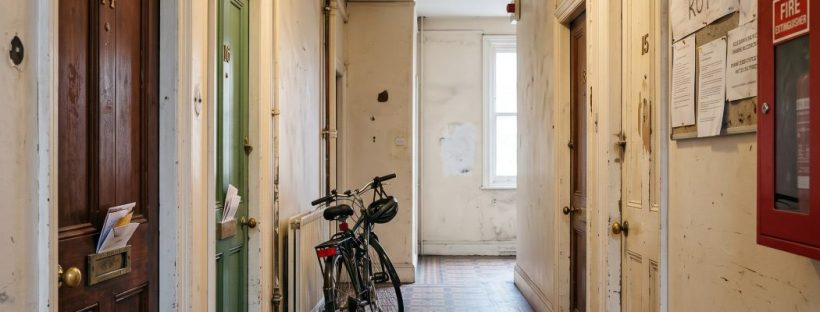
Ask ten people in a mansion block who is meant to clean the stairs and you will get several confident, contradictory answers. It is the freeholder. It is the managing agent. It is whoever’s turn it is. It is nobody, which is why they look the way they do. The real answer is duller than any of those and a good deal more useful, and it is written down in a document most residents have never read past the first page.
So who is actually responsible – the freeholder or the residents?
In almost every London mansion block the communal areas – the entrance lobby, the stairs, the landings, the lift, the bin store – belong to the freeholder, not to any of the leaseholders. You own your flat on a long lease. You do not own the hallway outside your door, not even the stretch of it you cross every single day. And because the freeholder owns those parts, keeping them clean is the freeholder’s responsibility to arrange. That is the short answer, and it catches out people who assume that because they pay for the cleaning, the doing of it must somehow be theirs to sort out.
The lease is the rulebook
Every one of these questions has the same final authority: the lease. Your lease sets out what counts as the “common parts”, and it puts two obligations in place – the landlord must keep those parts clean and maintained, and you must pay a share of the cost through the service charge. So the two halves people muddle together are, on paper, quite separate. Whose job is it to arrange the cleaning? The freeholder’s. Who pays for it? You do, along with every other leaseholder, split between you as the lease dictates. I am a cleaner, not a solicitor, so for anything genuinely contested the wording of your own lease is the last word – but that split is the pattern in nearly every block I have worked in.
If leaseholders pay for it, why does the freeholder arrange it?
It sounds back to front – you foot the bill, but someone else picks the cleaner. The reasoning is that the communal parts are shared, so one party has to take charge of them on everyone’s behalf, and the lease hands that role to whoever owns them. In practice the freeholder rarely lifts a finger themselves. They appoint a managing agent, and the agent runs the block day to day: collecting the service charge and hiring the contractors who actually turn up with the mop. That cleaning contract usually covers the halls, the staircases, the lobby, the communal glass and the bin store on a set rota – daily in a grand block, weekly in a modest one.
Where the managing agent fits in
So the cleaner in your hallway on a Tuesday morning is almost never employed by the freeholder, and never by you. They work for a cleaning company hired by the managing agent, who acts for the freeholder and pays that company out of the service charge you and your neighbours fund. It is a chain with several links, and every link is somewhere the standard can quietly slip. In the grander blocks there may still be a porter or caretaker on site – a tradition London has largely let fall away – who oversees or even does some of the cleaning, but even they answer back up the same chain. The managing agent is the one you deal with when things go wrong. On paper they answer to the freeholder; in practice, since it is your money funding the whole arrangement, they answer to you as well, and the good ones behave as though they know it.
What about blocks that manage themselves?
Not every block leaves it to a distant freeholder and an agent. In plenty of London blocks the leaseholders have taken the reins, either by clubbing together to buy the freehold – share of freehold, as the estate agents like to advertise it – or by exercising the Right to Manage, which lets them take over the running of the block without owning the freehold at all. Either way, the job of arranging the cleaning moves to a company the residents themselves run.
Right to Manage and share of freehold
The catch, if it is one, is that self-management does not make the cleaning free or the responsibility disappear. It moves both onto the residents’ own management company, which still has to hire and pay a contractor out of everyone’s service charge, and still has to field the grumbling when the stairs are grubby. What changes is that the people making the decisions now live in the building, which tends to concentrate the mind. The blocks I see with the best-kept communal areas are very often the self-managed ones, where the person signing off the cleaner’s invoice also has to climb the stairs every night. Ex-council and housing-association blocks run differently again – there the landlord is the council or the association, and the cleaning is their duty, funded through rent or a service charge depending on how you hold the flat.
Where does “communal” end and your flat begin?
The boundary matters, because it decides what you can be asked to clean and what you cannot. What you own – your “demise”, in the language of the lease – almost always stops at the internal surfaces of your flat: your side of the front door, and everything behind it. The moment you step onto the landing you are in common parts. That worn patch of carpet outside your door, the tiled entrance hall you walk across with your shopping – none of it is yours to clean, and none of it is yours to neglect either. Many of these blocks still have their original encaustic tiled floors and stone stairs at the entrance, which want proper care rather than a slosh of bleach, and that too is the contractor’s remit, not yours.
The doormat and the fire-exit rule
Two things complicate the tidy version of that boundary. The first is the doormat, the potted plant, the bike, the buggy, the stack of parcels – the personal clutter that migrates out of flats and onto the landing. The common parts are meant to stay clear, on paper at least and in most leases, and increasingly it is a fire-safety matter as much as a cleaning one. A cluttered corridor is a blocked escape route, and agents across London have been clearing landings hard since the fire regulations tightened. The second complication is mess that one resident causes – the grit and dust tracked through the halls during a flat’s renovation, say. General cleaning is the contractor’s job; the trail of builder’s dust leading to your bathroom refit is yours, under the same lease terms that stop you making a nuisance of yourself to your neighbours.
What should you do if the hallways are filthy and nobody is cleaning them?
This is where most of the frustration lives, and where people most often do the wrong thing. If the communal cleaning is not happening, or is being done so poorly it may as well not be, the answer is not to roll up your sleeves. It is to hold the people already responsible to the standard you are already paying for. Start with the lease and the service-charge accounts, which between them tell you what cleaning you are entitled to and roughly what is being spent on it. Then put your complaint to the managing agent in writing, point at the specific obligation in the lease, and ask to see the cleaning schedule – how often it is meant to happen and what the contractor is actually signed up to do. A surprising number of blocks pay for a weekly clean, receive a monthly one, and have never once asked to see the paperwork. Do this collectively rather than alone where you can – a residents’ association, or a well-attended AGM, carries far more weight with an agent than one annoyed leaseholder ever will, and it spreads the effort so the whole thing does not land on a single person. If the agent stonewalls, the service charge itself can be challenged at the First-tier Tribunal, which can rule on whether what you are charged is reasonable and whether the service was in fact delivered.
Don’t reach for the mop yourself
Here is the part that goes against the grain: however filthy the hallway gets, do not start cleaning it yourself. I know the instinct – it is right there and quick, and a scrubbed landing is more pleasant than a dirty one whoever paid for it. But the moment a resident quietly takes over the communal cleaning, three things happen. The managing agent’s failure stops being visible, and the pressure to fix it drains away. The standard becomes whatever one tired neighbour can manage on a Sunday. And you begin doing, for nothing, the exact job your service charge is meant to buy, which cuts the ground from under you the day you finally do complain.
I watched this play out in a red-brick block on Prince of Wales Drive in Battersea, where one resident had spent the best part of a year mopping the main staircase herself because the contracted cleaner kept not turning up. Everyone was quietly grateful. Nobody chased the agent, because the stairs looked perfectly fine. When she moved out, the block found it had been paying, all that time, for a service it had not received in months, with not a single logged complaint to prove it. Her kindness had cost her neighbours a year of bargaining power.
The clean hallway you are owed is bought and paid for on your service charge; the work genuinely left to you is making the people you pay actually deliver it. So put the communal mop back where you found it. That staircase was a paid job before you moved in and it will be one long after you leave, and at no point in between does it quietly become yours.