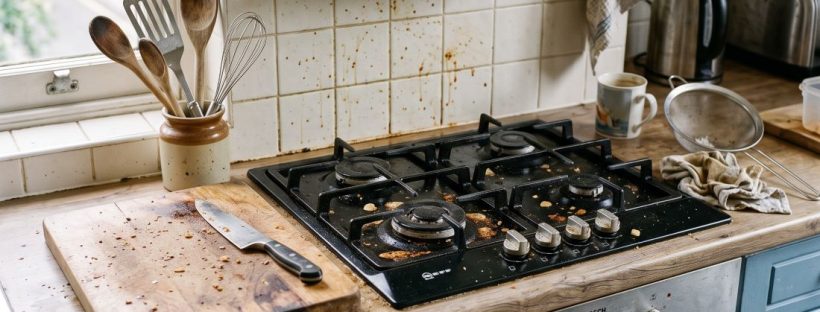
There are two kinds of grease on the splashback behind your hob, and only one of them ever comes off easily. The fresh splatter from tonight’s dinner wipes away with a damp cloth. The layer underneath – older and harder, gone a faint amber like a coat of varnish someone forgot about – does not budge, and that is the layer people mean when they say the grease behind the hob is impossible.
It is not, quite. But you have to stop treating it like grease.
Why does grease behind the hob turn hard instead of wiping off?
By the time it has gone amber and solid it is barely grease any more. It is polymerised oil, and the thing that made it is the same process that seasons a cast-iron pan – heat, oxygen and time, doing to your wall exactly what a chef does deliberately to a skillet.
When cooking oil turns to varnish
Every time you fry, a fine mist of oil lifts off the pan and settles on the wall behind. On its own that would wipe straight off. The trouble is that the splashback sits directly in the path of the hob’s heat, so every later time you cook, you bake that thin film a little further. Heat and oxygen make the oil cross-link, its molecules bonding into longer and longer chains, until the soft splatter has set into a hard golden lacquer that grips the surface the way seasoning grips iron. A gas hob is the worst offender, throwing grease-laden heat straight at the wall; induction is kinder, though it still spits. Whatever the heat source, you end up cleaning a coating that the cooking built on purpose, which is why a cloth and a squirt of washing-up liquid get you precisely nowhere.
The extractor hood is part of this story too. Its filter is meant to catch the grease-laden air before it can land anywhere, and when that filter is clogged or the fan is switched off, all of that oil goes onto the wall and the cupboard fronts instead. A splashback that keeps rebuilding its lacquer no matter how often you clean it is very often the sign of a hood filter nobody has touched in two years.
What actually cuts through baked-on grease?
Grease is undone by alkalis, not acids. An alkaline cleaner reacts with the fat and turns part of it into something soap-like and water-soluble – the same reaction, more or less, that soap-making has run on for centuries. So the useful cleaners are the alkaline ones. The alkaline options run mild to strong. Washing-up liquid handles a light film. For heavier build-up you want a dedicated kitchen degreaser, and the trade ones tend to be stronger than the supermarket sprays, or you fall back on good old sugar soap. Bicarbonate of soda worked into a paste adds a little gentle scrub where you want it.
Warm everything first. Grease softens with heat, so a warm surface and a warm solution do half the job before you have wiped a thing – run the tap hot, and I do mean hot, or give the wall a minute under a hot damp cloth to take the chill off it. One safety line while we are here: never mix a degreaser, or anything else, with bleach in that cramped corner behind the hob. The fumes are no joke in a space with poor airflow.
For the rare fleck that shrugs off even a warm degreaser and a proper wait, a dab of white spirit on a cloth will dissolve pure oil where water-based cleaners stall – fine on glass and glazed tile, though not on paint or plastic, and always with a window open. Most kitchens never need to go that far. Plain washing-up liquid, given enough heat and dwell time, clears the great majority of everyday build-up on its own.
Give it time, not muscle
Here is where most people lose the battle. They spray and wipe it straight off, then scrub harder when nothing happens. The chemistry needs time. Spray or paste the degreaser on, then walk away and leave it – five minutes for a light film, ten or fifteen for a bad one, and I do mean leave it, not hover an inch away with the cloth in your hand. When you come back the lacquer has gone soft and slack, and it lifts off with a non-scratch pad and almost no effort. If a patch holds on, put more on and wait again rather than reaching for the wire wool. Warm, wet and alkaline – that is the whole method, and the scrubbing you were bracing yourself for is the part you can mostly skip.
Does the vinegar-and-bicarbonate trick actually work on it?
Short answer: no. Not on baked-on grease, anyway.
Bicarbonate of soda is a mild alkali. Vinegar is a mild acid. Tip them together and they cancel each other out, fizzing up into carbon dioxide and salty water – sodium acetate, if you want the name for it – with none of the alkalinity that would have cut the grease and none of the acidity left either. The dramatic foam everyone loves is the sound of your two ingredients neutralising themselves. Apart, they each earn their place: bicarbonate as a gentle scrub, vinegar for limescale and the cloudy marks hard London water leaves on glass. Poured over grease as a pair, they do next to nothing except look busy in a video.
None of which makes the pairing worthless everywhere. Tipped down a sluggish drain the fizz gives a mild mechanical flush, and bicarbonate on its own is a fair deodoriser for a bin or a fridge. The mistake is carrying that reputation over to a job it cannot do. Grease on a hot wall needs sustained alkalinity, and a reaction that burns itself out in thirty seconds of foam has nothing left to give it.
One or the other, never the fizz
A tenant on Bellenden Road in Peckham had a glass splashback the colour of weak tea, years of the previous occupant’s wok cooking baked onto it. She had found the vinegar-and-bicarbonate trick somewhere online and gone at it for most of an afternoon, and the glass was every bit as amber when she finished as when she started, only wetter. A warm alkaline degreaser, left to sit for a quarter of an hour, took most of it off in a single pass. The volcano makes a good clip for your phone. It does not make a clean wall.
How do you clean it off glass, tiles or steel without scratching?
The right method changes with the surface, and so do the ways to ruin it.
The razor blade held flat
On a toughened glass splashback – the default in half the new London kitchens I walk into – the degreaser does most of the work, and for the last baked-on flecks a razor blade or a window scraper laid flat against the glass, at a shallow angle, will shave them away without leaving a mark. Flat is the word that matters. Tip the blade up and you will score the glass for good. Keep the surface wet the whole time you are scraping.
Tiles themselves are easy; the grout is the weak point, because grease soaks into the porous lines and yellows them. That wants a stiff-bristled brush, the degreaser worked right into the joints, then a proper rinse. Regrouting a hob splashback is a miserable Sunday, so it pays to keep the lines clean before they stain for keeps.
Stainless steel marks easily and scratches more easily still. Work with the grain of the metal rather than across it, and use a soft cloth in place of any kind of pad. Keep bleach and anything chlorine-based well away from it – chloride pits stainless steel, and that damage does not buff back out. On the cheaper acrylic and laminate panels, keep solvents and abrasives off altogether; they cloud and scratch, and once the surface has gone dull it never comes back clear. If your splashback is only painted plaster, go gently, because a strong degreaser will take the emulsion off with the grease.
One thing worth knowing about glass: it feels tough enough to take a green scourer, and it will survive the scourer, but the fine scratches you leave behind dull the surface and give the next round of grease somewhere to key into. The blade held flat does no such damage. And the mist travels much further than the splashback itself – the underside of the extractor and the tops of the nearest cupboard doors quietly pick up the same film, and want the same degreaser when you get round to them.
How do you stop it building up again?
Nearly all of this is avoidable, and the window for avoiding it is narrower than people think.
The ten-second habit
The whole problem is that fresh grease wipes off and hardened grease does not, and the gap between the two states is short – a matter of cooks, not weeks. Wipe the splashback down while it is still warm from the hob, a damp cloth and nothing else most nights, and the oil never gets the repeated baking it needs to set. Ten seconds while the pan is still ticking on the ring behind you. Do that and the lacquer never forms. Skip it for a month and you are back to the degreaser and the fifteen-minute wait.
The same discipline pays off one shelf up. Pull the metal filter out of the extractor hood every month or two and either run it through the dishwasher or stand it in a sink of hot water with a good slug of degreaser until the grease floats loose. A clean filter catches the oil that would otherwise have ended up on your wall, so the two jobs are really one job done in two places.
Left long enough, the only thing that takes it off is a razor blade held flat to the glass, the amber coming away in little curls you can lift with a fingernail.