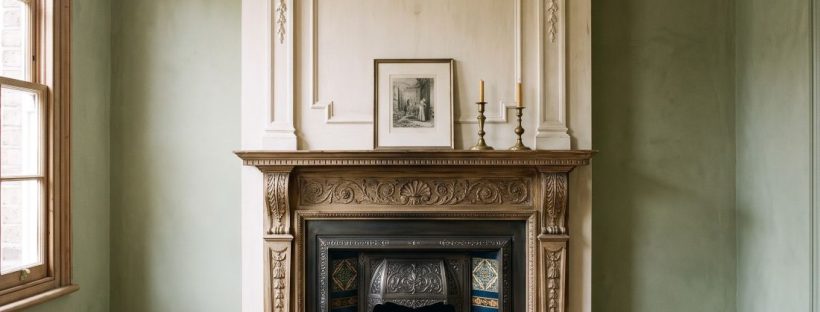
Scrape the paint off a chimney breast in almost any Victorian terrace between Walthamstow and Tooting and you find the same thing underneath. A grey-brown film, greasy to the touch and settled into the plaster since before anyone in the street had heard of the Clean Air Act. It does not want to move. Ordinary cleaning slides it around rather than lifting it, and the harder you go at it with a wet cloth the further into the surface it works.
So most of what people do to a sooty chimney breast makes it worse.
Why is the soot on a London chimney breast so hard to shift?
Coal. For the better part of a century the fireplace on that breast burned coal every winter, and coal soot is not simple dust – it is fine carbon, oily tar and water-soluble salts. The tar is what makes it greasy, so it grabs at any cloth you bring near it. The salts are the real trouble: they pull moisture out of the air, which is why a stain you were certain you had beaten comes back as a damp brown shadow every February.
A hundred years of coal fires
London burned more coal, for longer, than almost anywhere on earth. The soot on an original breast is not last winter’s leftovers – it is decades deep, drawn into soft lime plaster that is thirsty and holds onto everything it drinks. On a breast that has been painted several times over, the soot ends up sealed in a layer between the plaster and the paint, hidden but not gone, waiting for damp to carry it back up. And in a front room lived in for a hundred years the soot rarely sits alone – decades of cigarette smoke and the fine grease that drifts in from cooking bake onto the same warm wall, layered over it until the whole breast reads as one flat brown. This is the fact that governs everything else here. You are almost never removing soot from a London chimney breast. You are managing it.
Where do you start, and why not with water?
Dry, always. The instinct is to fill a bucket and get scrubbing, and it is the wrong first move by a distance. Water turns loose soot into a thin black wash that you then drag across the whole breast and press into every pore of the plaster. Wet, it is in for good, and rinsing afterwards only spreads the black wider.
The dry soot sponge
Before any of this, open the windows and lay dust sheets over everything you would rather not repaint later, because dry soot removal throws a fine black powder into the air that finds every surface in the room. Test your method on a low, hidden corner first. And keep the melamine ‘magic’ foam pads away from a breast still wearing old distemper or soft period paint – they abrade, and on fragile paintwork they cut straight through to the plaster underneath.
Start with a vacuum – a soft brush head, held a whisker off the surface, taking up everything loose before you touch the wall with anything else. Then reach for a dry soot sponge, sometimes sold as a chemical sponge or a dry-cleaning sponge: a slab of vulcanised rubber that lifts soot by grabbing at it, used completely dry. Never wet it. You wipe in straight, overlapping strokes from top to bottom, and you do not scrub in circles, because circling grinds the black back in as fast as you lift it. The sponge loads up fast. When one face turns grey, turn it over; when the whole thing is grey, slice the dirty layer off with a bread knife to expose clean rubber underneath and carry on. A single breast can eat half a sponge.
Only once you have taken off everything that will come off dry does a damp step make any sense. For a painted breast, a weak sugar-soap solution and a well-wrung cloth will lift the greasy residue the sponge leaves behind. Work from the bottom upwards – dirty water running down over an area you have already cleaned stains far less than it does running over one you have not – and rinse with clean water as you go. Wear gloves, because sugar soap is hard on skin, and because your hands come away black to the wrist regardless of what you do.
How do you get soot off exposed brick without wrecking it?
On an exposed-brick breast the rules tighten, because the surface you are cleaning is now soft, porous and irreplaceable. Take the loose material off with a soft-bristled brush and the vacuum, working the brush along the mortar joints where soot gathers thickest. For staining that has soaked into the face of the brick, a poultice – a paste laid on thick, left to draw the stain out as it dries, then scraped away – does more, and does it far more gently, than any amount of scrubbing. What you keep well away from old London brick is acid. Brick-cleaning acids and the stronger patio products will scorch the soft face and throw up a white salt bloom for months afterwards. They leave the wall looking worse than the soot ever did. And no pressure washer. Not near soft nineteenth-century brick, not ever. If you do end up with bare brick, resist the urge to varnish or seal it to lock the soot in – old brick needs to breathe, and a trapped, sealed face pushes moisture back out as blown, powdery salt.
Why bare brick is a decision you might regret
Stripping a London chimney breast back to bare brick is, most of the time, a mistake. The yellow London stock brick behind your plaster was laid to be covered. It was never a finish surface, never fired or chosen to be looked at, and it is often sooty right through rather than just on the skin. Bared, it sheds fine dust onto your mantelpiece for years and soaks up every future speck of grime through its open pores. Cleaning it properly after that means damaging it. The exposed-brick breast looks wonderful in an estate agent’s photograph and behaves like a permanent grime trap in a real front room used by real people who cook and light candles. If the plaster is sound, repair any cracks and paint over it.
Why does the stain keep bleeding back through fresh paint?
This is the failure I am called out to more than any other on period breasts, and it is always the same story. Someone cleans off the soot as best they can and rolls ordinary emulsion over the top, pleased with the result – and within a fortnight, or over the first damp winter, a brown shadow rises through the fresh white like a bruise coming up under skin. They repaint. It comes back. They repaint again, heavier this time. It comes back again.
The reason is chemistry. Bad painting has nothing to do with it. Emulsion is water-based, and the tar and salts left behind in the soot are partly water-soluble, so every wet coat you roll on re-wets the old stain and gives it a fresh route up into the new paint. This can carry on for as many coats as you have patience and money for.
One check before you prime, though. Make sure what you are looking at is soot bleeding through and not active damp coming down from a leaking flue or a missing chimney pot. Shellac seals a stain; it does nothing for a wall that is genuinely wet, and sealing over real damp only pushes the trouble a foot along the plaster. If the patch feels cold and wet to the back of your hand rather than just marked, that is a different job, and a bigger one.
Shellac, not emulsion
A tenant on Cazenove Road in Stoke Newington once showed me a chimney breast she had painted three times over a single winter, each coat a little more desperate than the last, the same tea-coloured stain ghosting back through every time. Nobody had told her about primer. The way to stop this is to seal the soot under something water cannot get through, which emulsion is not. A shellac-based stain-blocking primer – the spirit-borne kind, Zinsser BIN being the tin most decorators reach for – isolates the soot completely. One coat, sometimes two over a bad patch, left to dry hard, and the stain is locked behind a barrier water cannot cross. Then your emulsion goes on top and stays the colour you painted it. On that Stoke Newington breast, two coats of shellac and a fresh top coat did it, and it has stayed white since. The soot is all still there behind it. It simply has nowhere left to go.
When is it a job for someone else?
Some of this is not a cleaning job at all. If the plaster on the breast is blown – hollow and crumbling when you tap it with a knuckle – no amount of careful surface work will rescue it, and you want a plasterer who has handled lime plaster, not a general one who will trowel gypsum over a soft old wall and trap damp behind it.
The sweep and the survey
If the building is listed, altering or removing an original fireplace or its surround can need listed building consent, so check before you start prising anything off the wall. And if the fire still draws, or you are tempted to light it, get the flue swept by a certified chimney sweep before anything else. Heavy old soot deposits sometimes point to an unlined or damaged flue, and that is a safety matter that sits well beyond the look of the wall. The same applies if you find the flue has been blocked off and capped at some earlier point – opening it back up for a stove or an open fire is specialist work, not a weekend job with a borrowed chisel.
The soot on that breast has been there longer than you have. Seal it properly and it will still be there long after you have gone – quiet under good paint, exactly where you left it.