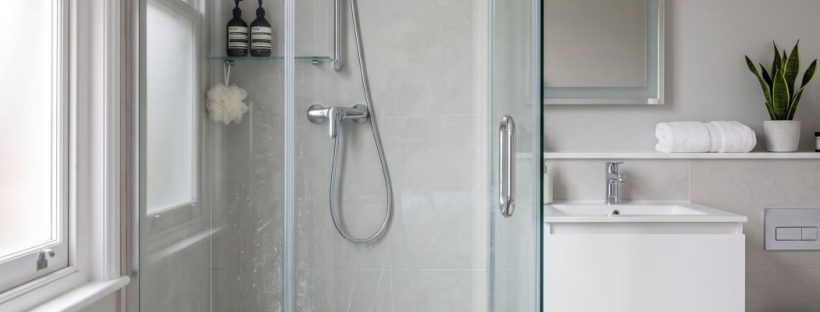
A clear glass shower door has about a fortnight of good behaviour in it before London water starts leaving its mark. With a working extractor fan you might stretch that. Without one, you won’t. The wet air has nowhere to go, so it settles on the glass, dries there, and leaves behind everything the water was carrying.
That is the whole problem, really. The water evaporates on the glass instead of leaving with the steam.
Why does London water turn shower glass cloudy so fast?
London sits on a great slab of chalk, and the water that reaches your taps in Croydon or Camden has spent years filtering down through it. By the time it arrives it is hard – among the hardest supplied anywhere in Britain, with mineral readings across most of the Thames Water and Affinity areas that put the capital firmly in the “very hard” bracket. Every droplet that dries on your shower screen leaves a microscopic ring of calcium behind. Repeat that a few hundred times and the glass takes on a haze that ordinary cleaning simply will not shift.
The chalk under the city
Soap makes the whole thing worse. When the minerals in hard water meet the fatty compounds in shower gel and bar soap, they bond into a dull grey film that grips glass far more stubbornly than either could alone. It is properly welded on. A fan drags the damp air out of the room before much of this can settle. Take the fan away and the bathroom stays warm and wet for the best part of an hour after you have finished – every tile and seal getting a longer soak than it should. So the cloudiness you are fighting is not one substance but two, layered, and the second one is the reason a quick pass with a damp cloth achieves nothing at all. You wipe, it smears, it dries cloudy again by evening. This is also why the same shower can look filthy in a Streatham conversion and stay glassy in a modern block half a mile away – the water is identical, but one bathroom clears its own air in ten minutes and the other holds it for an hour. The glass is only ever reporting on how long the room stayed wet.
What actually keeps the glass clear day to day?
One tool does more than every spray and cream combined, and it costs about six pounds. A squeegee. Not a cloth, not a chamois – a rubber-bladed squeegee, kept on a hook inside the enclosure where you cannot avoid seeing it.
The squeegee habit
The logic is simple. Limescale forms when water dries on the glass. Remove the water before it can dry and there is nothing left to form. So you pull the squeegee down the screen the moment you turn the shower off, top to bottom, overlapping each stroke slightly, while the glass is still warm and everything comes away in seconds. Thirty seconds, done properly, and the door is dry. Skip it and you hand the minerals exactly the conditions they want.
I will be blunt about this, because it is the part everyone tries to wriggle out of. There is no product, no coating, no clever spray that replaces the squeegee in a bathroom with no extraction. People want to believe otherwise. They want the bottle that means they never have to think about it again, and that bottle does not exist. If you are not willing to spend half a minute a day, nothing else in this article will keep your glass clear for long. It really is that simple, and that annoying.
The habit is the hard part, not the technique. It helps to make the squeegee the last thing your hand touches before you step out, hung at eye level rather than tucked into a corner where reaching for it becomes a faff. Some people keep a second one on the outside of the screen for the panel that faces the room. And once the glass is squeegeed, leave the door wide open. A closed enclosure with no fan is a sealed box of warm damp air, and warm damp air is precisely what feeds the film you are trying to prevent. Open it up and let whatever airflow the room has do its work.
There is one more small thing worth building in: a final cold rinse. Turn the temperature right down for the last few seconds and run cold water over the glass before you squeegee. It knocks the temperature of the panel down, cuts the steam, and gives you slightly less to pull off. Nobody enjoys it in January. It works anyway.
Do all this and you can go a fortnight without proper cleaning. Ignore it and you are back to a limescale battle you can never quite win, waged with ever-stronger chemicals against glass that only gets duller.
How do you ventilate a bathroom with no fan and maybe no window?
Getting the moisture out of the room is the other half of the job, and it is harder when the architects clearly never intended anyone to breathe in there. Plenty of London bathrooms are internal – a windowless slot carved out of a hallway during some 1980s conversion, with a fan that either never existed or gave up years ago.
The dehumidifier question
If there is a window, open it, and open it before you shower rather than after, so the room is not already saturated by the time you start. Leave the bathroom door open too. Cross-flow between the two clears the air faster than either on its own.
Where there is no window at all, a small dehumidifier earns its keep. Run it for an hour after each shower and it will pull litres of water out of the air that would otherwise end up on your glass and your grout. I remember a garden flat off Ladywell Road in Lewisham where the shower sat in what had plainly once been an airing cupboard – no window, a fan that hummed but moved nothing, black mould creeping along the ceiling line. A £40 dehumidifier and a squeegee turned it round inside a month. The mould was a bigger job and a separate one, but the glass came clear and stayed clear, which nobody in that flat had thought possible.
One thing not to do: leave a bath towel draped over the screen overnight. That traps moisture against the glass for eight hours and undoes everything the squeegee bought you. Hang wet things anywhere but there.
What removes limescale once it is welded to the glass?
Sometimes you inherit the problem. New flat, cloudy door, no idea how long it has been allowed to build. At that point prevention is beside the point and you need to strip the glass back to something like its original state.
Vinegar, citric acid, and what to keep off the glass
Acid dissolves limescale, and you have two cheap ones to hand. White vinegar works – warm it slightly, soak a cloth, press it flat against the glass and leave it twenty minutes so the acid has time to bite, then work it over with a non-scratch pad. Warming the vinegar is a faff, granted, but a cold soak barely touches a heavy deposit. Citric acid, a couple of spoonfuls in warm water, does the same job with less of the chip-shop smell and, to my nose and hands, a bit more bite on the stubborn stuff. For a screen that has gone genuinely opaque you may need a dedicated limescale remover and a second pass. Rinse thoroughly and – you saw this coming – squeegee it dry.
What you must keep away from the glass is anything abrasive. Wire wool and the green side of a washing-up sponge will both scratch, and scratched glass holds limescale worse than smooth glass ever did, because now the film has somewhere to key into. Cheap toughened panels mark more easily than you would hope. Once the surface is scored there is no undoing it, so the moment of frustration where your hand drifts towards the scourer is the moment to put the kettle on instead and let the acid do the waiting for you.
Are water-repellent coatings worth it, or a waste of money?
Here is where I part company with half the internet. Water-repellent coatings – the car-windscreen type in a bottle, or the pricier nano-sealants a company will apply for you – are oversold for domestic bathrooms, and in a room with no extraction they are close to a waste of money.
What the sealant actually buys you
The theory is sound enough. The coating makes water bead and run off, so less of it lingers to dry. In a hard-water bathroom used every single day, though, these treatments wear thin within weeks. The high-touch zone around the handle goes first, then the strip where the water hits hardest, and you are left with a screen that is protected in patches and cloudy in others – to my eye worse to look at than an untreated one, because the eye catches the join. The professional coatings last longer and cost a great deal more, and they still need the daily squeegee to earn their price. So you are paying a premium to keep doing the thing that already works for six pounds on its own.
There is a narrow case for a coating, and I will grant it: a screen you have just spent an afternoon stripping back to clear glass takes the treatment better than a tired one, and applied to a fresh surface it can buy you a slightly easier squeegee for a few weeks. Fine. Treat it as a top-up, not a substitute, and do not be surprised when it fades. What you should not do is fit a coating and quietly drop the daily habit, which is exactly what most people do the moment they have paid for one.
Spend the money on a good squeegee and, if the room truly needs it, a dehumidifier. That is the honest version of the advice, even if it sells nothing.
A clouded shower door in a London flat is a drying problem dressed up as a cleaning one. Sort the drying and the glass mostly looks after itself. Everything else is a squeegee you have not picked up yet.